What is a crochet pattern?
A crochet pattern is a set of written or charted instructions that tells you which stitches to make, where to place them, and how many you should have. It normally includes materials, yarn weight, hook size, finished measurements, abbreviations, construction notes, and instructions divided into rows, rounds, or pieces. You do not need to memorise the whole pattern: read one instruction, work it, and confirm the stitch count before continuing.
Begin with the pattern overview
Before making a slip knot, read the title page and project notes. Identify the skill level, finished measurements, yarn weight, hook size, terminology, gauge, and every technique the designer expects you to know. This first pass tells you whether the project matches your experience and gives you time to practise an unfamiliar stitch.
- Confirm whether the pattern uses US or UK terms.
- Check whether the project is worked in rows, rounds, or both.
- Gather every material, including stitch markers and finishing tools.
- Read assembly notes before cutting any long yarn tails.
Decode abbreviations one piece at a time
Crochet patterns use abbreviations to keep repeated instructions compact. In US terminology, ch commonly means chain, sc means single crochet, hdc means half double crochet, and dc means double crochet. Designers should include a key because abbreviations can vary. Keep that key beside the instructions instead of trying to memorise everything immediately.
Understand repeats and punctuation
Asterisks, brackets, and parentheses group instructions. An asterisk usually marks a sequence you will repeat. Brackets often contain a longer repeated group, while parentheses may group stitches worked into the same place or show the final stitch count. Conventions vary, so check the pattern notes first. Read the complete round aloud before starting, then identify exactly where the repeated section begins and ends.
- (sc, inc) × 6 means repeat one single crochet followed by one increase six times.
- sc 12 means work one single crochet in each of the next twelve stitches.
- A number at the end of a round usually states the stitch total you should now have.
Rows and rounds behave differently
Rows are worked back and forth, often with turning chains. Rounds travel around a shape. Joined rounds end with a joining stitch, while continuous rounds flow directly into the next round. For continuous amigurumi rounds, place a stitch marker in the first stitch and move it after every completed round.
Treat stitch counts as checkpoints
The stitch total is your built-in error detector. Count at the end of every shaping round, particularly after increases, decreases, or a long repeat. If the count is wrong, return to the last round that matched instead of forcing the next instruction to fit. Correcting one round is usually faster than repairing a misshapen piece later.
Separate pattern reading from tension
Following the written stitches correctly does not guarantee the intended size if your tension differs from the designer’s. Gauge describes how many stitches and rows fit within a measurement. For fitted garments it is essential. For amigurumi, focus on a firm, even fabric that keeps stuffing hidden while remaining comfortable to crochet.
Use a simple pattern for practice
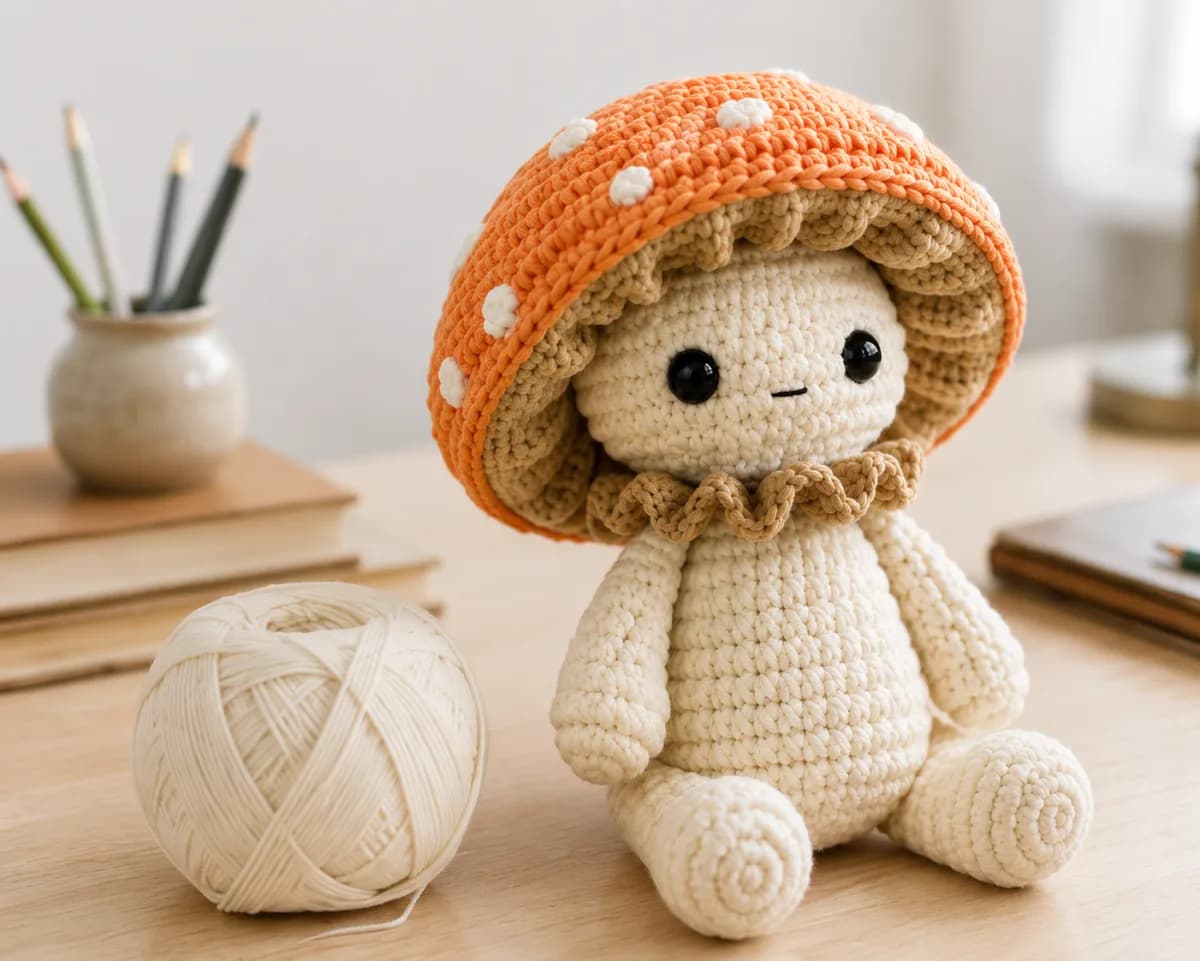
Choose a small project with clear materials, a short abbreviation list, visible stitch totals, and helpful photographs. Read one round, translate it into plain language, crochet it, and check the count. The free Happy Mushroom pattern uses continuous rounds, increases, invisible decreases, back-loop rows, and assembly, making it a useful next step once the basic amigurumi rhythm feels familiar.